Showing posts with label Beatlick Joe Speer. Show all posts

Sunday, March 22, 2020

BEATLICK JOE SPEER


 BEATLICK JOE SPEER WEEK at 'Bradlaugh's Finger' has featured, thanks to Joe's partner Pamela Hirst, some great writing by and about Joe. But I've saved the most moving piece until last. The following is the last entry from Joe's journal. He was dying from pancreatic cancer. It wouldn't be long before he left his body for whatever plane we find ourselves on next. In this one relatively short entry Joe wrote his own epitaph, almost: here is a poet's attitude to his art as he faces the end of his life. He knew what he had contributed to poetry and he understood that he didn't need to say anymore. He had other things to do now. 'The rest,' as Shakespeare says, 'is silence.' (BH)


Joe Speer's Final Journal Entry

“Are you writing a lot,” Terry asked for the second time? I guess she thinks I should be scribbling away between pain pills that having an expiration date on my life should enhance my writing. My answer both times was no, mostly because I don’t feel like writing. I’m happy to lie down, after finding a comfortable position, close my eyes and enjoy the warmth of a zipped up sleeping bag. Plus I don’t know that my death tinged words would be more valuable than a poem I had written in my vim and vigor days. Regardless of how I feel I usually only put pen to paper when I am consumed with a good idea or a strong theme that needs flushing out. If Terry thinks I should run out the clock while trying to extend my fame into the future, a few last minute shots to increase my total points scored. I don’t find that inspirational. I’ve made some contributions to the poetry scene over the years. My goal has always been to serve literature, not use writing to promulgate my own personality. Fortunately, literature will continue on whether I write profusely while coughing up blood or never write another word. The quality of its devotees is the important point. These servants follow in a long line one after another. Someone is waiting to take my place. 
available on Amazon

Friday, March 20, 2020

CAROL MOSCRIP


available on Amazon

Joe, The Poet

He, with the broad freckled face and riveting green eyes,
take another look at his edgy tattoo
coming out from under his baggie shorts long to mid-calf,
dresses young like a beachcomber,
whose pants slip off with a single gesture,
no underwear,
big pockets to tuck poems into,
and shells and whole crabs and sides
of small boats beached just for him 
to swallow whole into his vast collection of stuff,
from the engine that roars all day, all night,
rising to expand, withdrawing to the edges of itself
and then from his belly the poem vibrates 
as he talks of trucks and deserts 
and the wilderness of sexual pursuits 
in the original woman/man garden.


Carol Moscrip co-edited Beatlick Joe Speer's posthumous collection 'Backpack Trekker: A 60's Flashback'.


Thursday, March 19, 2020

BEATLICK JOE SPEER


available on amazon


(from) Backpack Trekker: A 60’s Flashback

TREK 55

        In 1969 four-hundred students at Harvard University seize buildings as part of a campus-wide strike.

I enjoy long flights while looking out the window at rivers and empty ball parks. When the clouds blocked the view at 30,000 feet I read "Uncle Tom's Children" by Richard Wright. It is right to say he left a rich mark on literature. He introduced a new element into American fiction. He created a tension from the possibility of random violence. H.L. Mencken taught him how to use words as weapons. 
     In the story "Big Boy Leaves Home" three Negro men go skinny dipping in a lake. There are no signs of trouble until a white man appears with a rifle. He kills two of the men but Big Boy manages to kill the white man. Later, while trying to secure a hiding place, he beats a snake to death with a stick. From a hide-out he watches a friend get burned with hot tar and gas. He strangles a barking dog that sniffs him out and threatens to dis-close his presence. Big Boy is pursued by the vigilante commit-tee but he escapes to the north. 
     Richard Wright escaped to Paris in 1946. In 1953 with the publication of his novel "The Outsider", he culminated the work of the Harlem Renaissance and joined forces with French existentialism. Wright died in Paris in 1960 and his ashes are interred at Père Lachaise. He shares the cemetery with other exiles such as Oscar Wilde and Jim Morrison. 
     The stewardess asked if I wanted a drink. Her skin was the color of a cooked pinto bean so I assumed she was a Latina. I replied in Spanish that I wanted a beer. She popped the cap on a Corona and we bantered back and forth in Spanish. She complimented me on my accent and asked where I learned to speak Español. I explained that I read Antonio Machado. My father served in Spain during their civil war. He accompanied Machado into southern France and was at his bedside when the poet died in exile in 1939. 
     She asked if I was familiar with Federico García Lorca. I told her my mother was a student at Columbia University in 1929. My mom provided the lonely poet with a conversation partner. He gave her a hand-written poem called "La Aurora" which he signed “Federico”. She kept it until 1936 when she showed it to a neighbor who inadvertently spilled a blotch of ketchup on it. Lorca's name was smeared blood red. 
     We landed and like Dean Moriarity, I crossed the street into Mexico “on soft feet." 

Frederico Garcia-Lorca
by Fabrizio Cassetta

Tuesday, March 17, 2020

BEATLICK JOE SPEER


www.wyomingpublicmedia.org


(from) Backpack Trekker: A 60’s Flashback

TREK 33 

In 1969 the film “If It's Tuesday, This Must Be Belgium" presents a fast-paced comedy about Americans on vacation in Europe.

Devils Tower in Wyoming is one of the sacred rocks of North America. Why is this rock that rises abruptly from its base and looms 1,267 feet above the Belle Fourche River called Devils Tower? It could be God's Penis or Thor's Thumb.
The Indians have their legends as to how the rock was formed. A hunting party took refuge on top of a knoll as a grizzly bear clawed the surrounding area in a futile attempt to devour the warriors. When the bear relinquished its carnivorous quest, the Indians were left atop the rocky tower to starve.
The prairie dogs have their own version of how the tower was created. According to them, an ancient race of stalwart Neo-phytes dug a huge hole in the ground to bury their plates of ore. They collected their excrement and packed it over the plates until it hardened like a sedimentary rock.
After centuries of shit piling higher, the monolith was visible from miles around.
The arrival of the first prairie dogs into the area brought extensive digging. They dug until they found the plates and scratched them horrendously. When the plates were later discovered by a sun-baked wanderer and deciphered, the rodents cuneiform was put into a book and a religious sect established.
I camped out for two days near the sacrosanct stone, walking clockwise around its base and visiting with a few of the ninety plus bird species that have been sighted at this national monument.
The solemn stone collected heat during the day and slowly released it at night. Laying hands on the rock at night, I received images from the Paleozoic era.
   I became an absorber of rock vibrations, picking up instantaneous geomorphic communications from Half Dome in Yosemite, Ship Rock in New Mexico, Arches in Utah, Ayers Rock in Australia and the brooding sentinels of stone on Easter Island.
I was at the rock bottom of Devils Tower, using it as an antenna. The coyotes howled their nocturnal pronouncements. The prairie dogs scraped under the earth. All seemed serene and yet all was in flux around the great stone.
I felt the tower tremble. It blasted off the earth like a rocket ship, leaving me on the rim of a vast crater. I fell asleep and awoke at dawn near Meteor Crater in Arizona.


Avaliable from Amazon

Monday, March 16, 2020

BEATLICK PAMELA HIRST


www.abqjournal.com


Beatlick Joe Holds Court in the Desert

Late at night I hear laughter at the Evangelico Cemetery
poet Beatlick Joe entertains eighty six souls
raconteur extraordinaire cracking jokes from the grave
red ants vibrate out of their nests confused
ask the crickets what to do
coyotes in the Sandia Mountains howl and join the laughter
when that casket's rockin' don't come knockin'
leave them in peace, leave them in joy
Beatlick Joe holds his audience enthralled
high in the desert on a starry, starry night.


Available from Amazon 

Beatlick Joe Speer's ashes were buried alongside the ashes of 86 other souls in a single casket now interred in the Evangelico Cemetery, Albuquerque, New Mexico. You can read more about Joe's fittingly unusual last ride by following the link: "Poet Proud Among Paupers".

Sunday, March 15, 2020

JOE SPEER WEEK


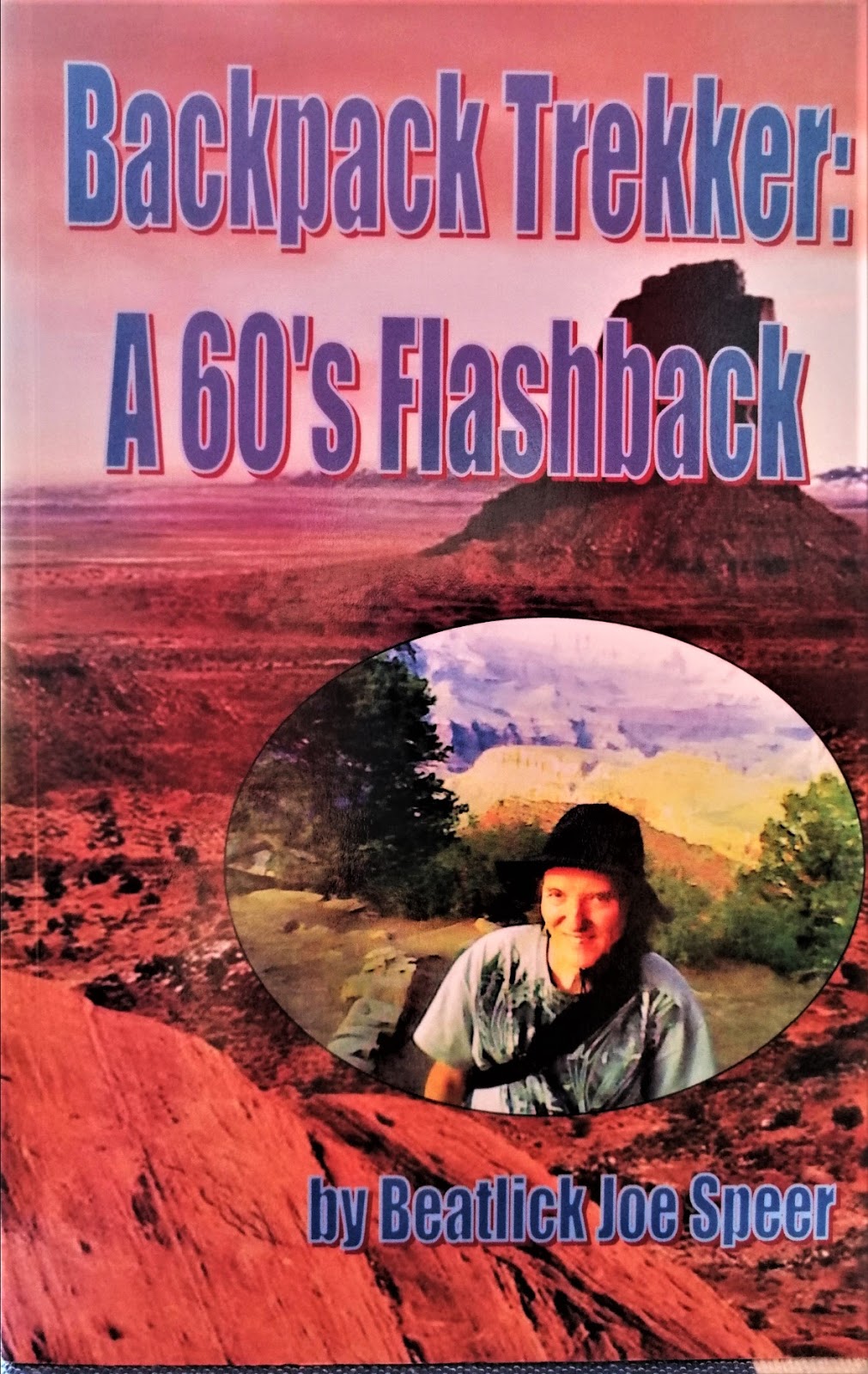
One of New Mexico’s own, Beatlick Joe Speer was an itinerate raconteur and performance poet, native of Albuquerque and a 1970 graduate of New Mexico State University. His only book, Backpack Trekker: A 60s Flashback, is his chronicle, his glorification of hitchhiking as a means of transportation, while it was in its prime.

‘Hitchhiking in America during that era kept one close to the Earth. It was a simpler time. The hitchhiker was not looked upon as a freak of nature. People were less insulated and more generous back then, trusting and willing to pick up a stranger. Our goals were simpler back then, too… find that campsite at the end of each day, find the next ride, the next town, the next festival.”

Published posthumously, Speer’s travel journals crackle with imaginative dialogue and soulful poetry; entertain with essays and reviews in his fields of research: literature and film of the 1920’s and 1960’s; and inspire with his minimalist philosophy – respect for Mother Earth and fellow man – and sparkling joy of life on the road serving the muse in the spirit of Beat writers Jack Kerouac and Neal Cassady.

His literary footprint is large, his newsletter Beatlick Poetry Newsletter is archived in five universities and two public libraries. His personal library is located in the Branson Library saved in Special Collections at the NMSU.  (Pamela Hirst.)


Backpack Trekker: A 60’s Flashback

TREK 27

In 1969 Margaret Atwood’s “The Edible Woman” reveals the life of a young woman whose structured and consumer-driven life alters drastically.

When I was a student, the majestic peaks of the Grand Tetons made me wish I could fill my dorm room with rocks. I didn't want imported beer bottles, or old Christmas cards or calendar girls straddling motorcycles on my shelf. I wanted to adorn my study area with rock formations. But I settled for books and LP's because they were easier to move at the end of the semester. The best plan was to visit the rocks in their own habitat.
I encountered the wonderment of random rocks as I hiked a trail to Lake Solitude. It was in this remote locale that I met a Buddhist monk.
The monk had been there for seven days. He spoke English as well as seven other languages. Our minds closed ranks on the third day as rain pelted the rocks. It turned out that we both wrote poems so we created a piece alternating lines:

You and I were in a dream together
asleep under a rhododendron leaf
protesting second-hand smoke
a retired poet injected you with a free-will serum
desert winds were born from your wound
and activated the machinery of fraudulence
as the infernal blue buzz crawled through the rubbish
of our collective DNA
through the canebrake of verbiage


Beatlick Joe Speer


 All material used with permission.